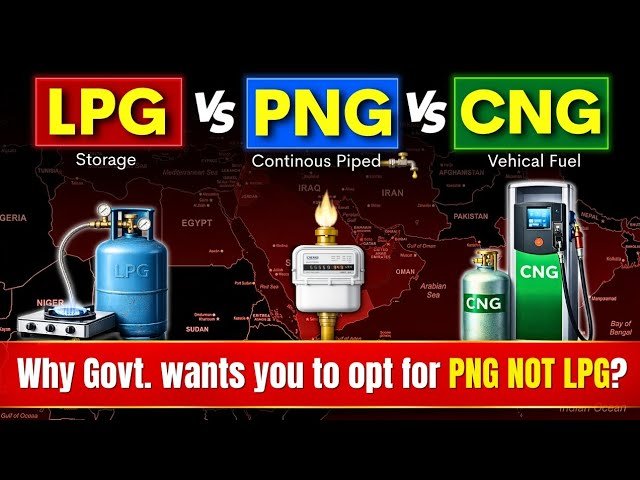
India is rapidly transforming its energy ecosystem, and one of the biggest changes happening right now is the shift from LPG cylinders to PNG connections. This transition is not just about convenience—it reflects a larger strategy focused on safety, sustainability, and energy security.
Let’s understand the difference between LPG and PNG and why the Indian government is actively promoting PNG.
What is LPG?
LPG (Liquefied Petroleum Gas) is a mixture of propane and butane gases that are stored in liquid form inside cylinders under pressure.
Key Features:
- Supplied in cylinders (commonly 14.2 kg for households)
- Requires booking and delivery
- Widely used in rural and urban India
- Heavier than air (can accumulate in case of leakage)
👉 LPG has been the backbone of India’s cooking fuel system for decades, especially under schemes like Ujjwala Yojana.
What is PNG?
PNG (Piped Natural Gas) is primarily methane gas delivered directly to homes through underground pipelines.
Key Features:
- Continuous supply via pipeline
- No need for cylinder storage
- Meter-based billing system
- Lighter than air (disperses quickly if leaked)
👉 PNG is mostly available in urban areas and is expanding rapidly across India.
LPG vs PNG: Key Differences
| Feature | LPG | PNG |
|---|---|---|
| Composition | Propane + Butane | Methane |
| Supply Method | Cylinder delivery | Pipeline |
| Availability | Nationwide | Mainly urban areas |
| Convenience | Needs refill booking | 24/7 supply |
| Safety | Higher risk if leaked | Safer (disperses quickly) |
| Cost | Expensive per refill | Pay-as-you-use |
| Environment | Moderate emissions | Cleaner fuel |
Why Indian Government is Promoting PNG
The Indian government is pushing PNG for several strategic and practical reasons:
Energy Security and Reduced Imports
India imports a large portion of LPG, which makes it vulnerable to global price fluctuations. PNG, supported by domestic gas production and pipelines, reduces dependency on imports.
Continuous and Reliable Supply
With LPG, users often face delays in delivery or booking issues. PNG provides uninterrupted gas supply directly to homes, eliminating these problems.
Improved Safety
PNG is lighter than air, so in case of leakage, it disperses quickly. LPG, being heavier, can accumulate near the ground and pose higher explosion risks.
Cost Efficiency
PNG users are billed based on actual consumption. This often turns out to be cheaper compared to buying full LPG cylinders, especially for smaller household
Environment-Friendly Fuel
PNG burns cleaner than LPG, producing fewer carbon emissions. This supports India’s climate goals and helps reduce urban pollution.
Government’s “One Nation, One Gas Grid” Vision
India is building a nationwide gas pipeline network to ensure uniform energy distribution. PNG plays a key role in this plan.
👉 In many cities, authorities are encouraging or even mandating a shift from LPG to PNG where pipeline infrastructure is available.
Latest Trend in India (2026)
- Thousands of households are voluntarily switching to PNG
- In some regions, LPG connections are being reduced where PNG is available
- Rapid expansion of city gas distribution networks is underway
👉 The shift clearly shows India’s long-term focus on pipeline-based fuel systems.
Which Fuel is Better?
Choose PNG if:
- You live in a city with pipeline access
- You want convenience and safety
- You prefer lower long-term costs
Choose LPG if:
- PNG is not available in your area
- You live in rural or remote locations
Final Conclusion
The LPG vs PNG comparison is not just about cost or convenience—it represents a major shift in India’s energy policy.
- LPG is reliable and widely accessible
- PNG is modern, safer, and environmentally friendly
👉 That’s why the Indian government is actively promoting PNG—to build a cleaner, safer, and more efficient energy future.